Feather Meal Fertilizer 12-0-0
- Regular Price
- $ 24.99
- Sale Price
- $ 24.99
- Regular Price
- $ 22.99
Sold Out
- Unit Price
- per
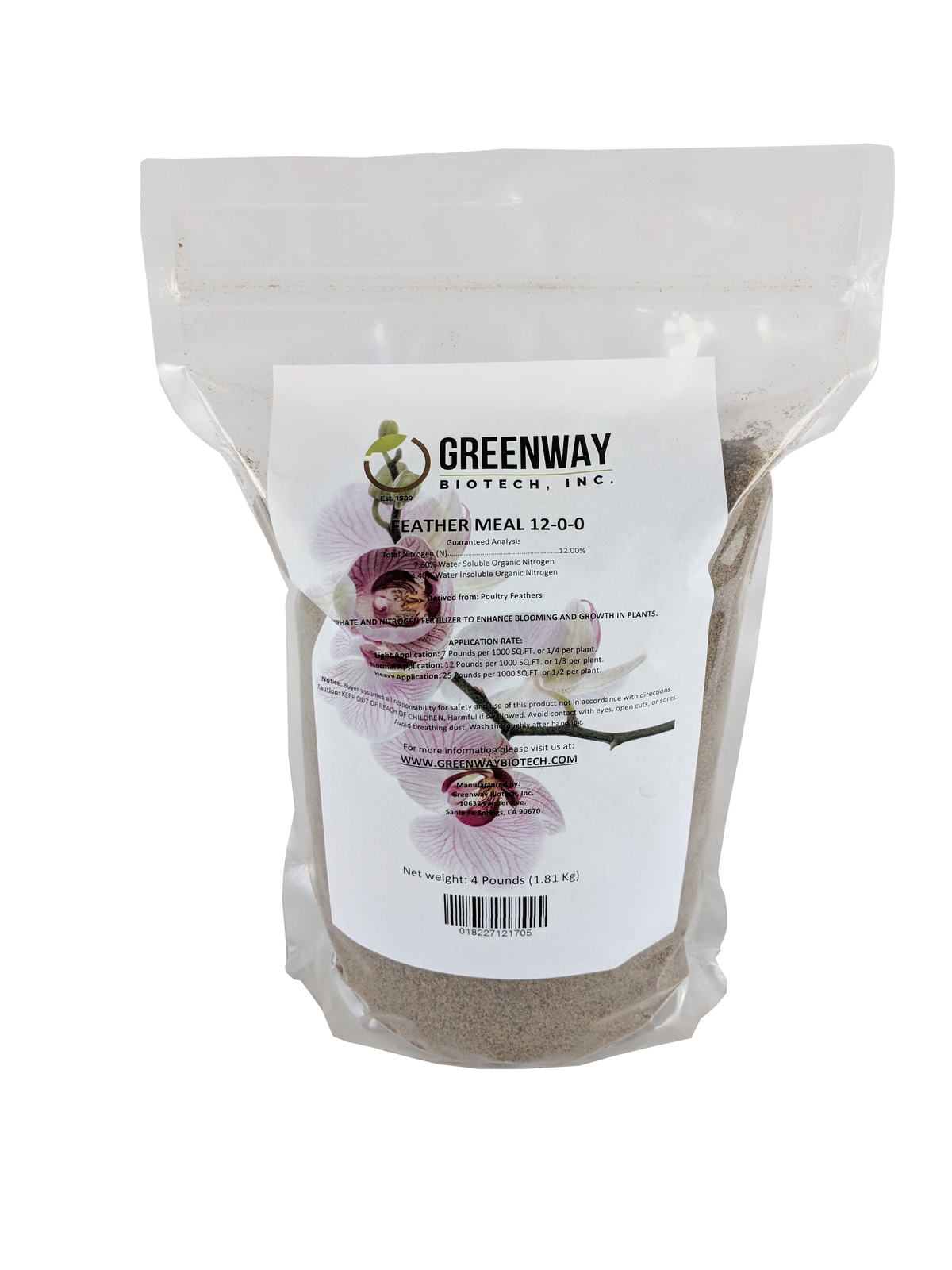
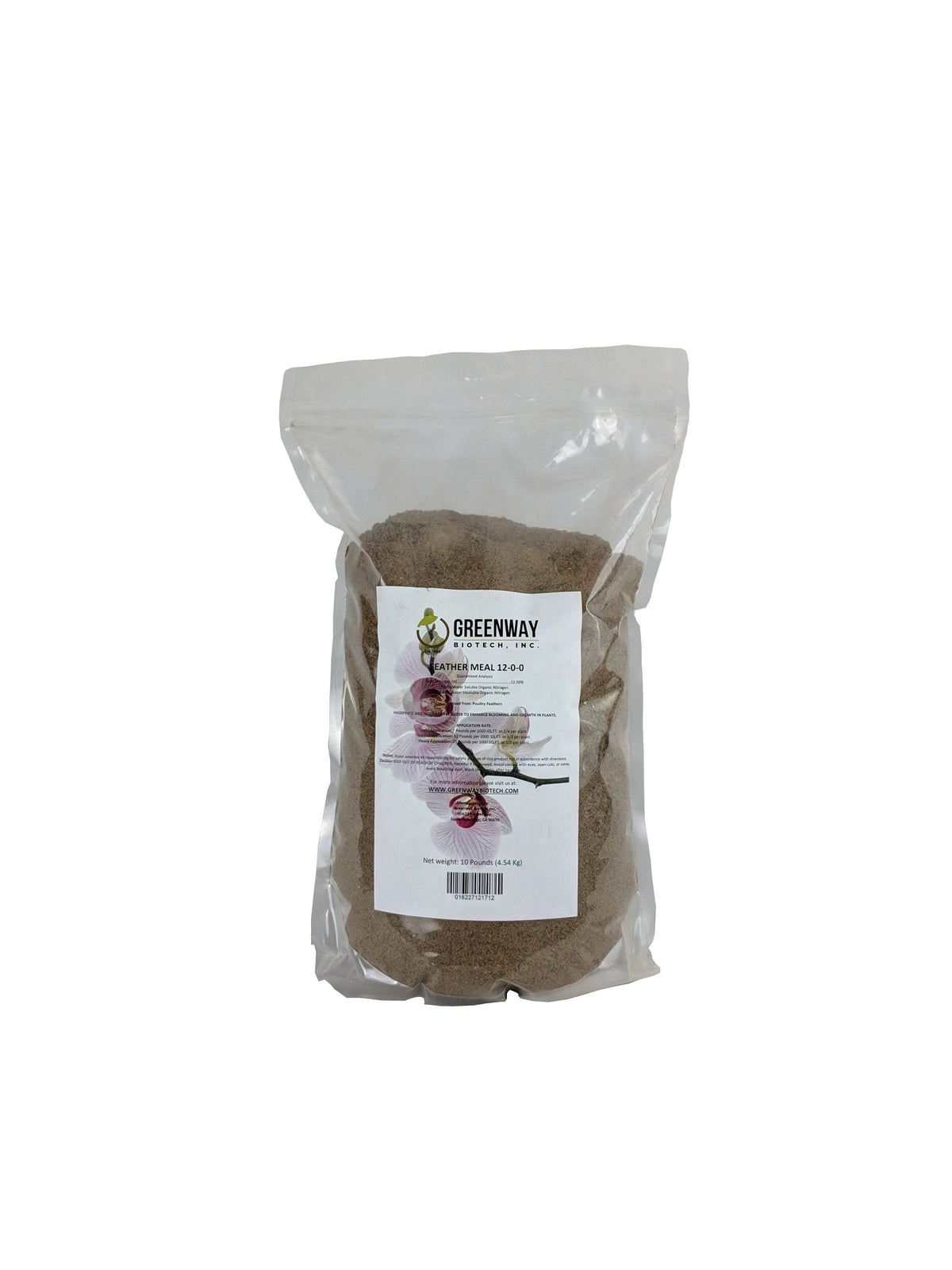
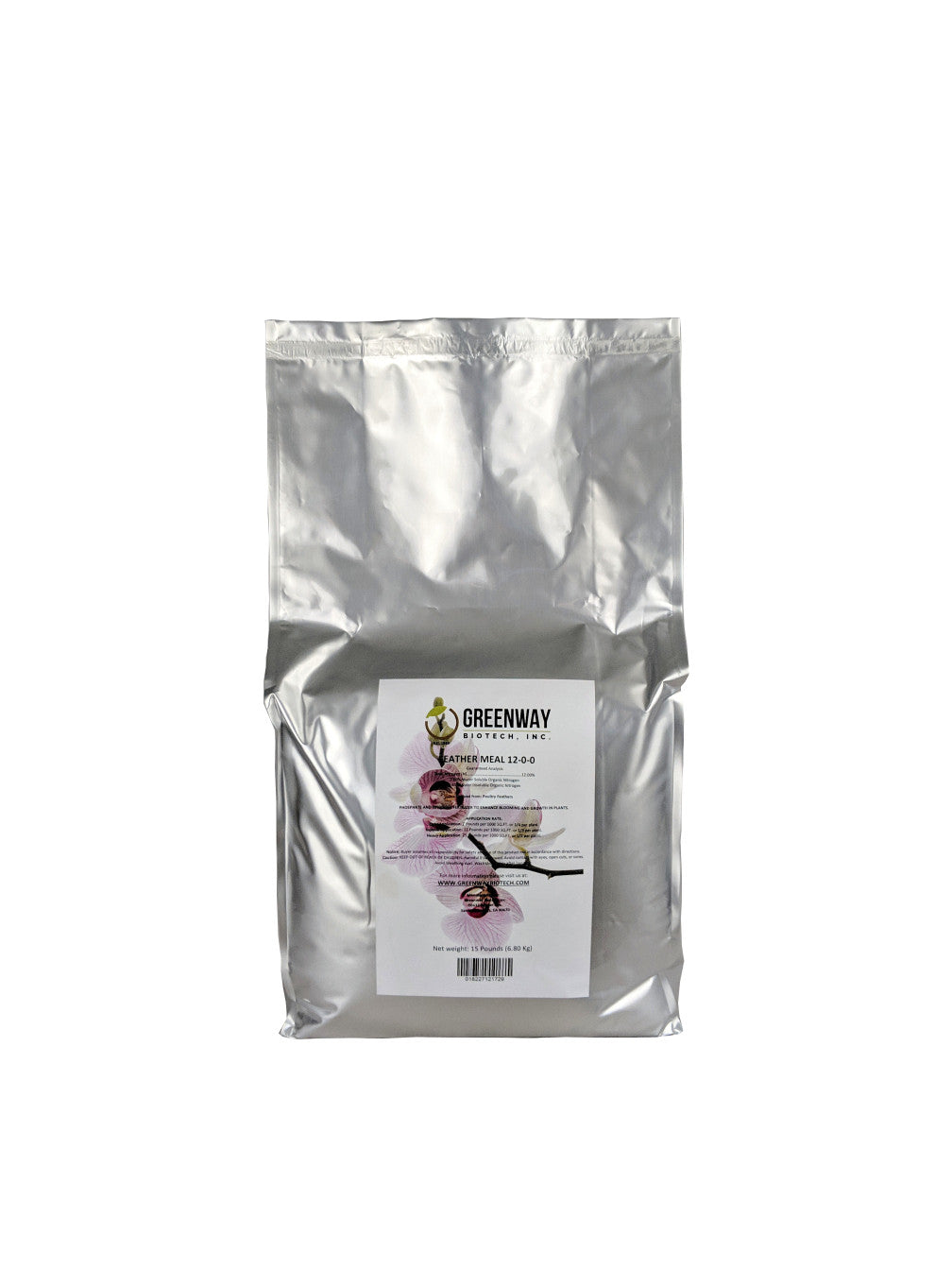
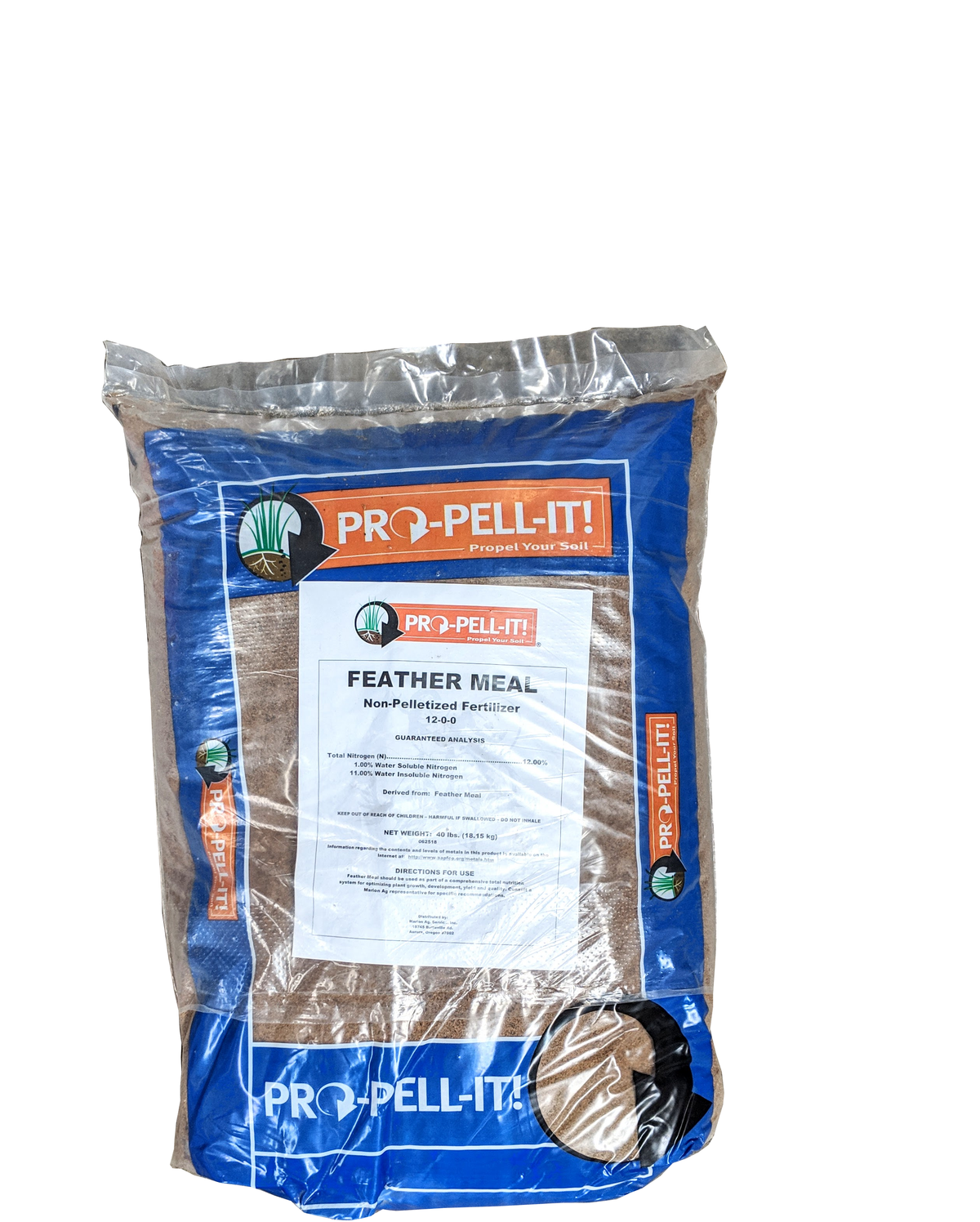
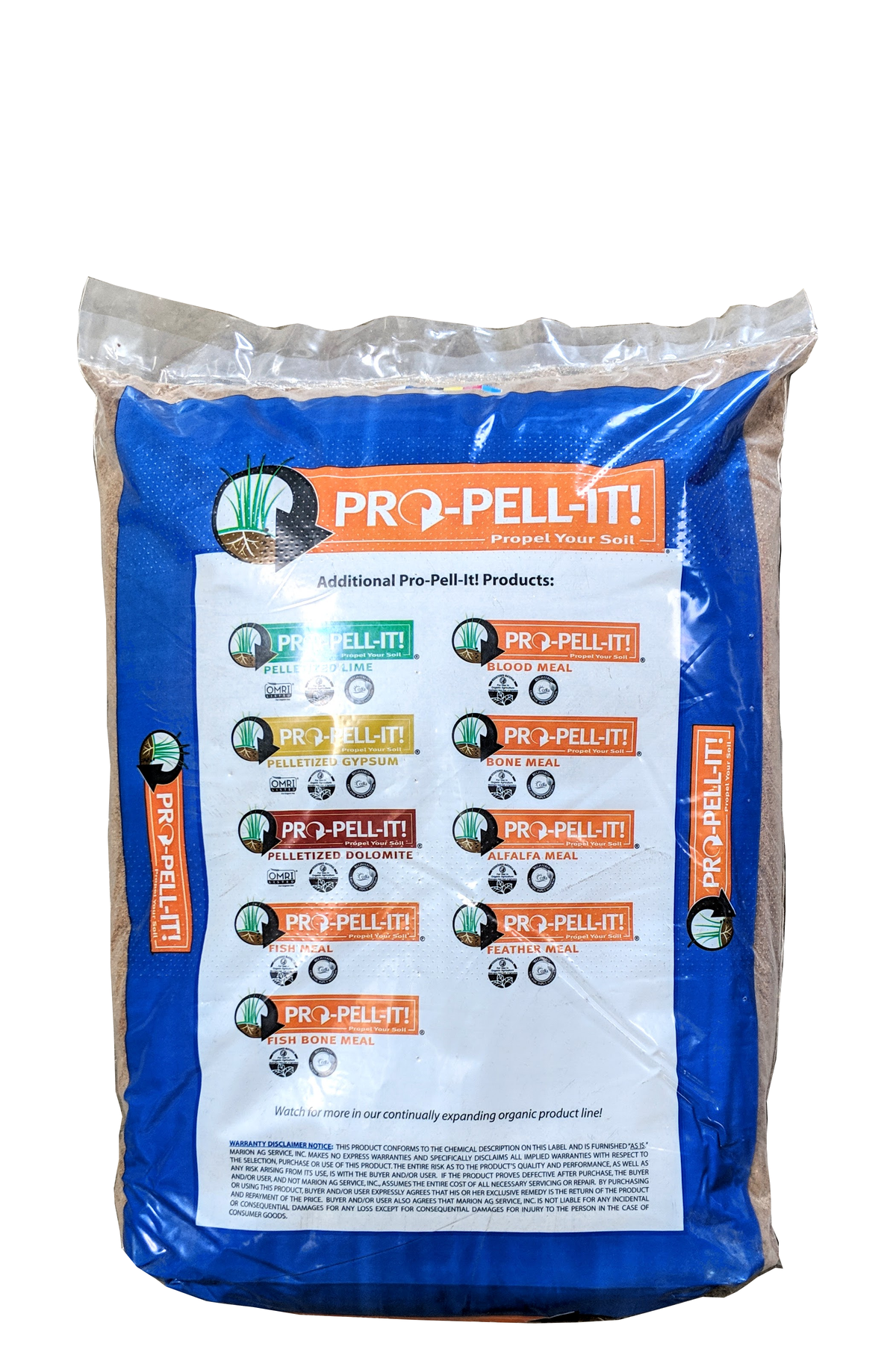
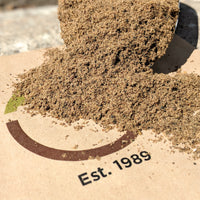
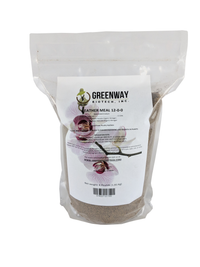
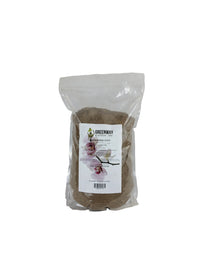
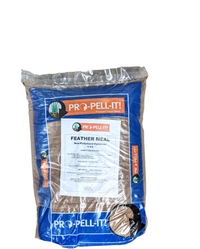
Nitrogen from hydrolyzed poultry feathers · 12-0-0
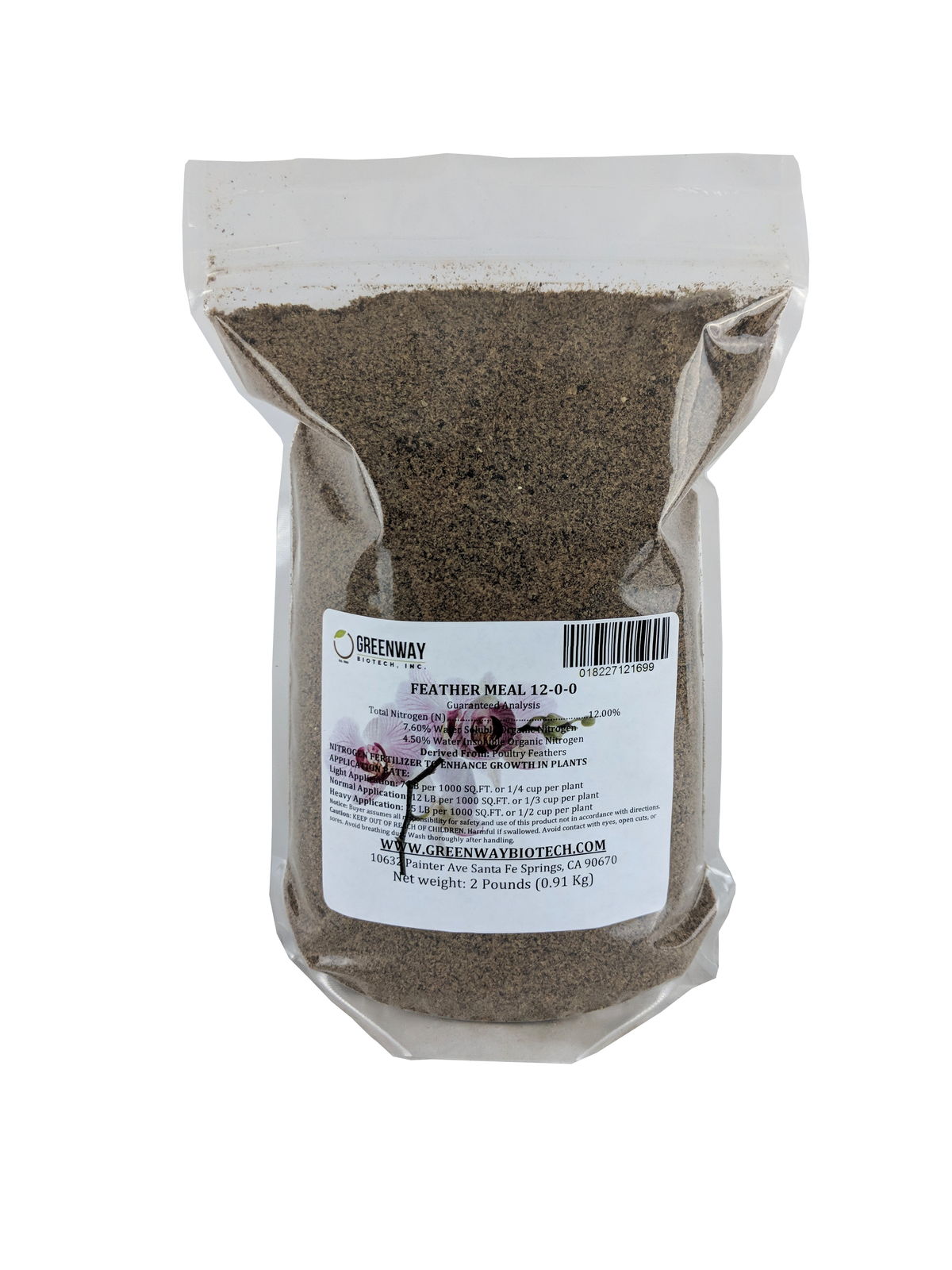
Feather Meal 12-0-0 is ground, hydrolyzed poultry feathers. It supplies 12% nitrogen, all of it in protein form, and no phosphate or potash. Soil microbes turn that protein into ammonium and nitrate, which roots take up. In warm, moist soil that happens within weeks, not months: in university lab tests about half of its nitrogen became available within two weeks and about 60% within four weeks, and release slowed after that.
Use it to supply nitrogen to vegetable beds, field crops, lawns, and fruit and landscape trees: weigh the amount for your planting, then work it into the soil, or water it into a lawn. It is not a months-long slow-release fertilizer, and it adds no phosphorus or potassium. It does not dissolve, so it is not for hydroponics, injectors, or sprays.
| Specification | Detail |
|---|---|
| Total nitrogen (N) | 12.0%, all of it water-insoluble nitrogen |
| Available phosphate (P₂O₅), soluble potash (K₂O) | None (the grade is 12-0-0) |
| Source | Hydrolyzed poultry feather meal, listed at 100% on the Safety Data Sheet |
| Nitrogen form | Feather protein (keratin). Roots cannot use it until soil microbes convert it to ammonium and nitrate. See How it works |
| Plant-available nitrogen | About 60% of the total in the first 4 weeks in moist soil (Oregon State University). By 10 weeks, Oregon State’s calculator predicts 75%, and Washington State University lists feather meal at 75 to 100% |
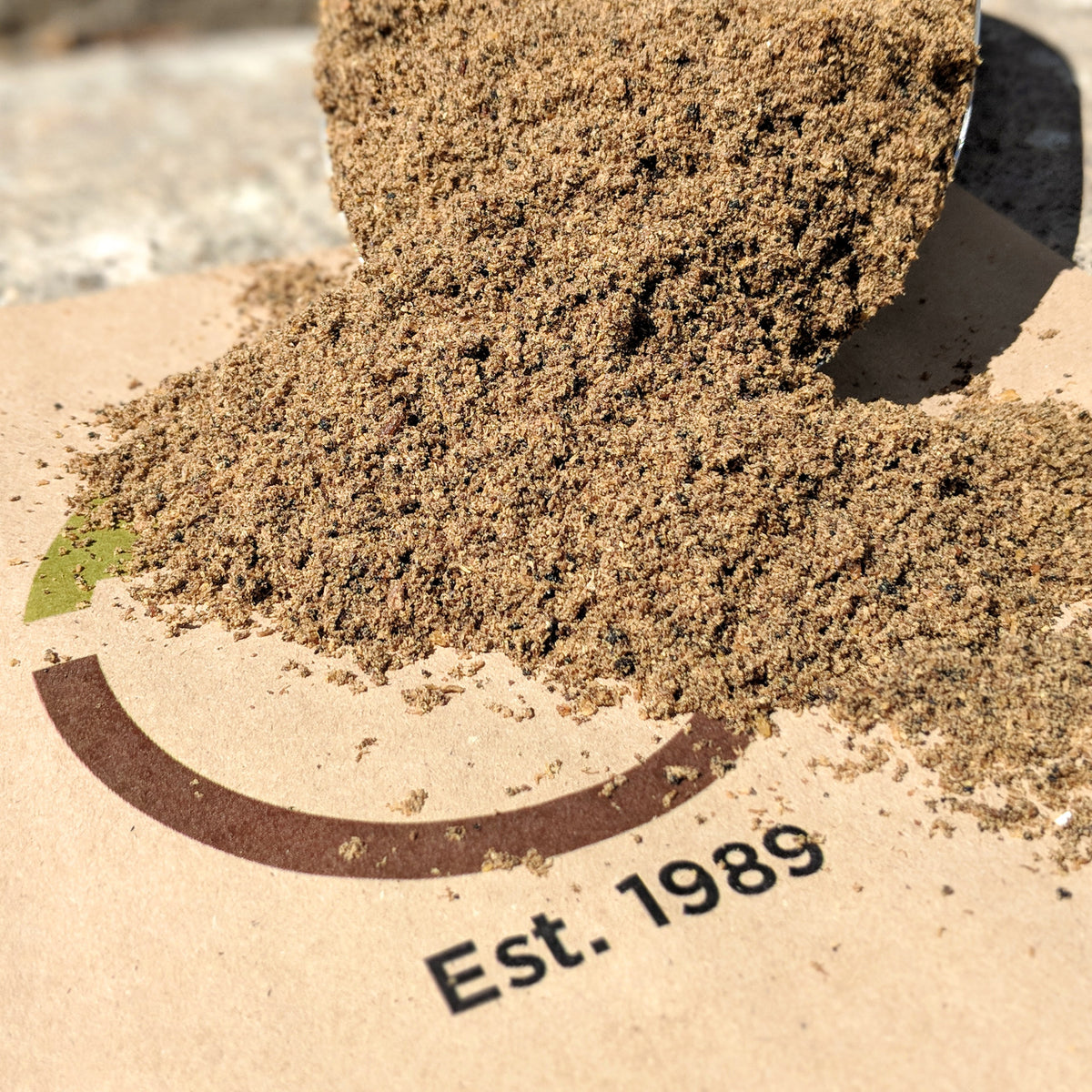
| Form | A dry meal in granules, powder, or pellets, light tan to medium brown, sometimes gray or yellow, with an earthy odor. Insoluble to slightly soluble in water |
| Hazards | Not classified as hazardous under the OSHA Hazard Communication Standard. The dust can irritate the eyes and airways. See Handling, storage & limitations |
| Package sizes | 2, 4, 10, 15, and 40 lb |
Percentages are by weight of product: 1 lb of feather meal contains 54 g (0.12 lb) of nitrogen, and a 10 lb bag contains 1.2 lb. At 75% plant-available, each pound supplies about 41 g (0.09 lb) of nitrogen the crop can use in its first season. The product supplies nitrogen only, so phosphorus, potassium, and soil pH are set by a soil test and other products. Weigh it rather than measuring by cup or scoop; this page gives no volume conversions.
Choose it when you want a concentrated nitrogen source from animal protein, applied to soil and worked in.
Washington State University sets most vegetable gardens at 2 to 2.5 lb of available nitrogen per 1,000 sq ft for the season, which is 2.2 to 2.8 lb of this product per 100 sq ft. Work it in at planting or shortly before. See Application rates.
The New England Vegetable Management Guide names feather meal as a sidedressing material and notes that many crops need nitrogen most about 3 to 4 weeks after transplanting. A pre-sidedress soil nitrate test can help set the rate.
Oregon State University plans fertilizers like this one by the plant-available nitrogen they supply, set against your crop’s nitrogen target. See the farm formula under Application rates.
University rates for lawns, fruit trees by trunk diameter, and trees and shrubs by root-zone area are given in pounds of nitrogen. Each pound of nitrogen takes 8.3 lb of this product.
Every amount below is product weight, spread evenly and worked into the soil. The rates come from the university publications named beside them, converted to this product’s 12% nitrogen. Start at the low end of a range, and let a soil test guide the program. If the directions printed on your package differ from this page, email questions@greenwaybiotech.com before applying.
Why garden and lawn amounts are figured differently. The garden and farm sources give the nitrogen a crop should actually receive in a season. Only about 75% of feather meal’s nitrogen becomes available to plants in that time, so those amounts allow for it. The lawn and tree sources give the total nitrogen applied, whatever the fertilizer, so those amounts use the full 12%.
| Crops | Available nitrogen per 1,000 sq ft | This product |
|---|---|---|
| Most vegetables | 2 to 2.5 lb | 2.2 to 2.8 lb per 100 sq ft (22 to 28 lb per 1,000 sq ft) |
| Heavy feeders: broccoli, sweet corn, potatoes | 3 to 4 lb | 3.3 to 4.4 lb per 100 sq ft (33 to 44 lb per 1,000 sq ft) |
Washington State University lists feather meal at 11 to 14% nitrogen with 75 to 100% of it available; this page uses 75%. It gives the heavy-feeder rate as 3 to 4 lb of nitrogen; this page treats that as available nitrogen, like the general rate. Soil organic matter supplies nitrogen too: Colorado State University halves the nitrogen for garden soils with 2 to 3% organic matter, compared with 0 to 1%, and calls for none at 4 to 5%, so a soil test can lower these amounts. Start with 2.2 lb per 100 sq ft (about 10 g per sq ft) for most vegetables.
Timing and placement. Broadcast it over the bed and work it into the top few inches at planting or shortly before. University of California guidance applies materials of this kind 2 to 4 weeks before the nutrients are needed; feather meal is one of the faster ones, releasing about half its nitrogen within two weeks in warm soil. Work it in soon after spreading: Gaskell and Smith note that prompt incorporation helps reduce nitrogen lost to the air. Do not put it in the seed row; Colorado State University warns that fertilizer in the seed row can injure roots. The amounts above are a season total. If you plan to sidedress long-season crops, hold part of it back for that; a pre-sidedress soil nitrate test can help set the sidedress rate.
Formula. Pounds of product per acre = the plant-available nitrogen your crop plan calls for (lb per acre) ÷ 0.12 ÷ the share available. Oregon State University’s organic fertilizer calculator credits materials like this one with 60% of their nitrogen at 4 weeks and 75% at 10 weeks, so 100 lb of plant-available nitrogen per acre takes about 1,110 lb of product by 10 weeks (25.5 lb per 1,000 sq ft), or 1,390 lb if the crop needs it within the first 4 weeks.
Take the nitrogen target from your own soil test, crop guide, or nutrient plan. As one example, Oregon State’s guide for the Willamette Valley sets medium-demand vegetables such as lettuce, tomato, and sweet corn at 100 to 150 lb of plant-available nitrogen per acre in organic transition and 50 to 100 lb in established organic systems. Oregon State’s calculator does not adjust for soil temperature, covers only the first 10 weeks, and recommends in-season soil nitrate testing to check the supply.
| Rate | Nitrogen per 1,000 sq ft | This product per 1,000 sq ft |
|---|---|---|
| Starting rate, per application | 0.5 lb | 4.2 lb |
| Maximum, per application | 1 lb | 8.3 lb |
| Yearly total, in 3 or 4 applications | 2 to 4 lb | 17 to 33 lb |
UC IPM puts lawns at 2 to 4 lb of nitrogen per 1,000 sq ft a year, depending on the grass species, usually in 3 or 4 applications of 0.5 to 1 lb each, and never more than 1 lb at one time. Iowa State University applies the same pounds of nitrogen whatever the fertilizer type, says hydrolyzed feather meal lawn products generally feed for about six to eight weeks, and notes that microbial release nearly stops at 41 °F. Apply it only while the grass is actively growing, sweep any product off pavement back onto the lawn, and water lightly after spreading.
| Trees | Nitrogen per inch of trunk diameter, per year | This product |
|---|---|---|
| Apple and stone fruit (peach, nectarine, plum, cherry, apricot) | 0.1 lb, up to 1 lb per tree | 378 g (0.83 lb) per inch, up to 8.3 lb per tree |
| Pear | 0.05 lb, up to 0.5 lb per tree | 189 g (0.42 lb) per inch, up to 4.2 lb per tree |
The University of Arizona starts fruit trees on nitrogen in their second growing season, applies it in spring, spreads it evenly under the tree, rakes it in lightly, and waters well. Colorado State University measures the trunk one foot above the ground, uses one-eighth pound of nitrogen per inch for stone fruits, and sets each year’s amount by the previous year’s growth: more if growth was weak, less or none if it was excessive. It adds that trees in a fertilized lawn may already get enough nitrogen from the lawn fertilizer.
Purdue University recommends 2 to 4 lb of nitrogen per 1,000 sq ft of root zone a year, applied 1 to 2 lb at a time in spring as buds swell and again in early fall; Washington State University gives 1 to 2 lb. In this product, 1 lb of nitrogen per 1,000 sq ft is 8.3 lb per 1,000 sq ft (378 g per 100 sq ft), the starting amount. Spread it over the root zone out to the drip line, as Clemson does, and water it in; Purdue spreads its rate over a wider area reaching half the canopy radius beyond the drip line, so the drip-line area gives a smaller amount per tree. The root-zone area in square feet is about 0.785 × the canopy diameter in feet × the canopy diameter: a 16 ft canopy covers about 200 sq ft, which takes 1.7 lb. Purdue advises against fertilizing trees and shrubs at planting, and Clemson calls water, not fertilizer, the key to getting new plantings established.
This page gives no rate for potting mixes, seed-starting media, planting holes, containers, houseplants, or citrus, avocado, fig, and other fruit trees outside the table above, and the product is not for hydroponics, injectors, or foliar sprays. For compost, see the compost question in the FAQ. For any of these, email questions@greenwaybiotech.com with your plants and growing method.
Formulas. Vegetable gardens and farms: pounds of product = plant-available nitrogen wanted ÷ 0.09 (12% nitrogen, 75% available). Lawns and trees: pounds of product = pounds of nitrogen ÷ 0.12. Fruit trees: 378 g (0.83 lb) per inch of trunk diameter (189 g for pears), up to 8.3 lb per tree. Multiply pounds by 453.6 for grams.
Worked examples. A 4 × 8 ft raised bed (32 sq ft) of most vegetables: 323 g (0.71 lb); a 2 lb bag covers it. A 100 sq ft garden: 2.2 lb (1,008 g); the smallest bag that covers it is the 4 lb. A 1,000 sq ft lawn at the starting rate: 4.2 lb; a 10 lb bag covers it, as do a 4 lb and a 2 lb bag together. An apple tree with a 4 inch trunk: 3.3 lb (1,512 g); a 4 lb bag covers it. One acre at 100 lb of plant-available nitrogen: about 1,110 lb; email questions@greenwaybiotech.com for a bulk quote.
| Bag size | Vegetable garden | Lawn |
|---|---|---|
| 2 lb (907 g) | 90 sq ft | 480 sq ft |
| 4 lb (1.81 kg) | 180 sq ft | 960 sq ft |
| 10 lb (4.54 kg) | 450 sq ft | 2,400 sq ft |
| 15 lb (6.80 kg) | 675 sq ft | 3,600 sq ft |
| 40 lb (18.1 kg) | 1,800 sq ft | 9,600 sq ft |
The calculator below asks what you are feeding and its size: bed or lawn area, trunk diameter, canopy, or acreage with your nitrogen target. It applies the university rate for that use, starting at the low end, states the nitrogen supplied, and recommends the smallest bag that covers one application, plus a lower-price combination of bags when one exists. Prices, tax, and shipping are confirmed at checkout, and availability is confirmed when you add to cart.
The calculator needs JavaScript. If it does not appear, use the rate tables and formulas above to choose a size.
Feathers are almost all keratin, a tough protein. Hydrolysis, the processing that turns feathers into feather meal, makes that protein digestible, and once the meal is in moist soil, microbes break it down to amino acids, then to ammonium, and nitrifying bacteria turn the ammonium into nitrate. Plants take up both ammonium and nitrate. None of the nitrogen is soluble in water when you spread it, which is why the Safety Data Sheet lists all 12% as water-insoluble nitrogen.
Insoluble does not mean slow here. In a University of California study (Hartz and Johnstone, 2006), feather meal released 30 to 50% of its nitrogen in the first week at 50 to 77 °F and 51 to 64% by four weeks, with little more by eight weeks. Oregon State University measured 63% at four weeks; a 1994 study found about 45, 55, and 65% at one, two, and eight weeks at 86 °F; and a 2021 model fitted to 113 published data sets put feather meal at 61% of its nitrogen in mineral form after 100 days at 77 °F. In University of Georgia field trials, blood, feather, and fish meals released inorganic nitrogen rapidly, within 2 to 4 weeks of application.
Warmth speeds the process and cold slows it. Oregon State uses the rule of thumb that release doubles with every 18 °F rise, yet the same studies show substantial release in cool soil: 48% in two weeks at 50 °F, and an average of 53% across high-nitrogen products in four weeks at 50 °F against 63% at 77 °F. Iowa State University notes that release nearly stops at 41 °F. In Georgia soils, feather meal released less nitrogen in the soil with the most clay (56% in 100 days, against 67 to 71% in the others), and low soil pH slowed the rate.
Blood meal behaves much the same. In the same University of California study, blood meal released 52 to 67% of its nitrogen by four weeks and 60 to 70% by eight weeks, slightly more than feather meal, and Oregon State measured both at 63% after four weeks. This describes feather meal as a material; it is not a trial of this finished product. For how feather meal compares with other nitrogen sources, see Related guides.
Match the nitrogen source to how quickly your crop needs it and how you apply it. Analyses are each product’s guarantee as shown on its page.
| Option | How its nitrogen becomes available | Choose it when |
|---|---|---|
| Feather Meal 12-0-0, this product | Microbial; about half in 2 weeks and 60% in 4 weeks in warm soil | You want a concentrated protein nitrogen source, worked into soil |
| Blood Meal 13-0-0 | Microbial; about the same speed as feather meal, slightly more by 8 weeks | You prefer its 13% nitrogen; use it the same way |
| Alfalfa Meal 2.5-0-2.5 | Little in the first month: 4% at 4 weeks (Oregon State) | You want organic matter with a little nitrogen and potash, not a main nitrogen source |
| Nitroform 39-0-0 | Synthetic ureaform; microbial release over months | You want slow-release nitrogen for lawns and trees and a synthetic is acceptable |
| Calcium Nitrate 15.5-0-0 | Soluble nitrate, available as soon as it is watered in; also 19% calcium | You need nitrogen now, or in water through drip or hydroponics |
12-0-0: hydrolyzed poultry feather meal with 12% nitrogen, all of it water-insoluble protein nitrogen, and no phosphate or potash. Each pound supplies 54 g (0.12 lb) of nitrogen. Soil microbes convert the protein to ammonium and nitrate before plants can use it.
Not in the months-long sense. Soil microbes have to convert its nitrogen first, so it acts more gradually than soluble nitrogen such as calcium nitrate, but faster than its reputation: in moist soil at 50 to 77 °F, university lab tests found about half of its nitrogen released within two weeks and 51 to 64% by four weeks, with little more by eight weeks; Oregon State University measured 63% at four weeks. Cold slows it but does not stop it: about 48% came out in two weeks at 50 °F, and Iowa State University notes that release nearly stops at 41 °F. Oregon State University plans on about 60% in the first month and 75% by 10 weeks.
No, not by much. In a University of California study at 50 to 77 °F, feather meal released 51 to 64% of its nitrogen by four weeks and blood meal 52 to 67%; by eight weeks blood meal was slightly ahead (60 to 70% against 55 to 64%). Oregon State University measured both at 63% after four weeks. Choose between them on nitrogen content and price rather than speed.
Washington State University calls for 2 to 2.5 lb of available nitrogen per 1,000 sq ft for most vegetables and 3 to 4 lb for broccoli, sweet corn, and potatoes. In this product that is 2.2 to 2.8 lb per 100 sq ft, or 3.3 to 4.4 lb for the heavy feeders, worked into the soil at planting or shortly before. Start at 2.2 lb per 100 sq ft, use less on soils high in organic matter, and keep it out of the seed row.
University rates are set by area, so work from the space each plant occupies. For most vegetables, 2.2 lb per 100 sq ft is about 10 g per square foot: a plant spaced 2 ft by 2 ft (4 sq ft) gets about 40 g, spread over that area and worked in, not placed in the planting hole. Broccoli, sweet corn, and potatoes take 15 to 20 g per square foot.
Divide the plant-available nitrogen your crop plan calls for by 0.09. Oregon State University credits materials like this one with 75% of their nitrogen by 10 weeks, so 100 lb of plant-available nitrogen per acre takes about 1,110 lb of product; if the crop needs it within 4 weeks, use 60% and about 1,390 lb. Take the target from your soil test or crop guide, and check the supply with an in-season soil nitrate test.
Yes, on actively growing grass. UC IPM sets lawns at 0.5 to 1 lb of nitrogen per 1,000 sq ft per application, never more than 1 lb at a time, and 2 to 4 lb a year in 3 or 4 applications. In this product that is 4.2 to 8.3 lb per 1,000 sq ft per application. Iowa State University says feather meal lawn products generally feed for about six to eight weeks. Water lightly after spreading and sweep any product off pavement.
For apples and stone fruit, the University of Arizona uses 0.1 lb of nitrogen per inch of trunk diameter a year, up to 1 lb per tree, and half that for pears, starting in the second growing season. In this product that is 378 g (0.83 lb) per inch (189 g for pears), up to 8.3 lb per tree, spread under the tree in spring and raked in. Colorado State University measures the trunk one foot above the ground and adjusts by last year’s growth.
We do not recommend it. Colorado State University warns that fertilizer in the seed row can injure roots, and in a University of Georgia study high rates of feather meal in a peat-based potting mix reduced tomato germination and increased seedling deaths. Purdue advises against fertilizing trees and shrubs at planting. Broadcast it over the bed and work it in instead; this page gives no container or potting-mix rate.
We do not hold an OMRI listing or a California Organic Input Material registration for this product, so we do not sell it for certified organic production. California requires fertilizing materials intended for organic crop production to be registered as Organic Input Materials. If you farm under organic certification, your certifier decides which inputs you may use.
Yes, as a nitrogen source for carbon-rich materials. University of Nebraska–Lincoln Extension adds about 1 lb of nitrogen for every 100 lb of dry sawdust and aims for about 30 parts carbon to 1 part nitrogen; from this product, 1 lb of nitrogen is 8.3 lb. Mix it through the pile.
It has an earthy odor. Work it into the soil after spreading, or water it into a lawn, so little is left on the surface, and keep the bag sealed and out of reach of children and pets, as the Safety Data Sheet directs. If a pet eats it, call your veterinarian.
Articles give background. For this product, use the rates and documents on this page.
The composition, hazard, storage, and first-aid statements come from the Safety Data Sheet above; the rates, release data, and cautions come from the university and research publications below, which describe feather meal and crop nutrition in general and do not evaluate or endorse this product.
Rates and sources reviewed October 20, 2026.
Not sure how much nitrogen your garden, lawn, or crop needs, or how to fit feather meal into your program? Email your plants, area, and any soil test to questions@greenwaybiotech.com, or call (562) 351-5168, Monday to Friday, 7 AM to 5 PM Pacific, and we will work through it with you.
Ready to buy? Calculate your amount & choose a bag
Every order carries a 90-day satisfaction guarantee, and we pack and ship from Madera, California. You can also choose a package weight from the size selector at the top of this page.
Greenway Biotech, Inc. is a family-owned company that has blended and packaged specialty fertilizers and soil amendments in California since 1989, today from Madera.